
Hoke Correctional Release Paths
Hoke Correctional Institution was a North Carolina state prison, not a county jail. Historic records place it at 243 Old NC 211 in Raeford. The North Carolina Department of Public Safety announced an operational suspension in September 2019, staff reassignment, and relocation of prisoners to other minimum-custody facilities. NCDAC now lists the institution as closed in February 2022.
That timeline changes how a former Hoke Correctional prisoner should be traced. A person who physically left the Raeford grounds during relocation remained in state custody at the receiving prison. A true prison release occurred later only when NCDAC recorded a discharge, expiration, parole, post-release supervision, court-ordered release, or another defined outcome. The statewide offender record, not the local detention line, is the primary source.
| Event | Custody meaning | Correct record |
|---|---|---|
| Relocation from Hoke CI | State custody continued elsewhere | NCDAC location and movement history |
| Actual release to supervision | Prison custody ended; sentence supervision continued | NCDAC status and sentence history |
| Sentence expiration | Represented prison term ended, subject to other holds | Actual Release Date and service status |
| Pickup by another agency | One custody event ended and another began | NCDAC record plus receiving agency |
Confirm Hoke Correctional Release
NCDAC's Offender Public Information Search covers state-prison offenders, probationers, and parolees, with historical information back to 1972. It excludes county-jail data. Start with the seven-digit offender number when possible because it stays tied to the state record even when names or locations change.
- Open the NCDAC Offender Locator and leave Offender Status on All. A released person can appear as an active supervisee or an inactive historical offender.
- Enter the offender number. If it is unknown, search the exact name and use birth date, age, middle initial, or other shown identity fields to separate namesakes.
- Open the offender-number result. Read Inmate Status and Probation/Parole/Post Release Status as two separate fields.
- Review the latest and historical incarceration blocks for locations, movement, sentence status, Actual Release Date, Projected Release Date, and parole dates.
- If another hold or transfer appears possible, check the named county, federal, or immigration source before describing community release.
Hoke Correctional Record Contacts
The historic Raeford prison is not a current release gate, so no active facility phone or hours should be inferred. NCDAC holds the state offender and release record. Its public-records page explains that basic conviction, sentence length, time served, admission, and release dates are public while much of the underlying offender file is confidential.
State offender and release records
Use the offender number and sentence period
NCDAC Public Records
Ask for an existing record rather than a new explanation. Identify the person, offender number, former Hoke CI placement if known, and the incarceration period. Request the admission and release dates, movement or receiving location, type of release, and supervision status fields that NCDAC can disclose. County jail booking records do not belong in this request because NCDAC expressly excludes local jail records from its scope.
Hoke Correctional Closure Record
The official closure evidence has two stages. The 2019 state announcement documented suspended operations, prisoner transfers across the state, and reassignment of staff. It also said Anson Correctional Institution would replace Hoke's South Central reentry role. NCDAC's closed-prisons list later recorded a February 2022 closure. Both facts matter, and neither should be collapsed into a claim that prisoners were discharged.
The official NCDAC closed-prisons list is shown in the saved source image below. Its Hoke entry supports the closed-facility description, while the individual offender record is still needed for any person's later release.
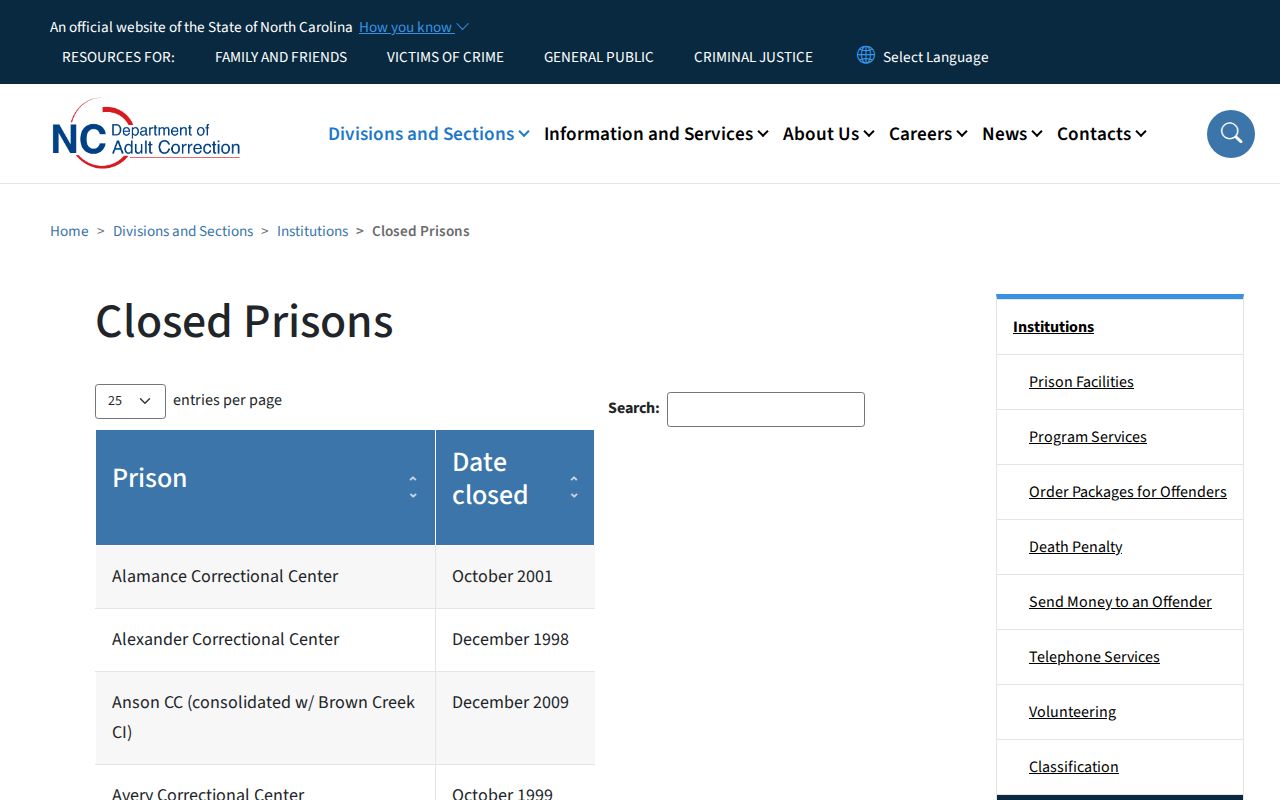
The image documents facility status, not a roster of former prisoners. Search NCDAC by offender number to trace a specific sentence or discharge.
Note: The closure list establishes facility status, while each person's NCDAC sentence history establishes any later transfer, supervision, or discharge.
Hoke Correctional Release Fields
The state record separates a calculated date from a completed event. Projected Release Date is forward-looking and can change with sentence administration. Actual Release Date records when the represented incarceration period ended. Neither field should be read alone. Service Status, Sentence Status, Inmate Status, supervision status, parole begin and end dates, and the latest location give the necessary context.
- Projected Release Date
- A calculated date used while the sentence is being administered, not a guarantee.
- Actual Release Date
- The retrospective end date for the represented incarceration block.
- Post-release supervision
- The community part of a Structured Sentencing felony term after prison custody.
- Inactive
- A useful search status for a completed NCDAC record, not proof that no older history exists.
An Actual Release Date can mark departure from the state incarceration event while another agency immediately assumes custody. NCDAC release procedure notes exceptions for pending charges, warrants, unposted bond, safekeeper return, and people without an approved residence. Pair the state record with the receiving agency when a destination or hold is shown.
Search Hoke State Releases
NCDAC maintains a separate monthly Inmate Release Search. It accepts a county, year, and month or a surname. Hoke is available as a county choice. Results show offender number, name, release date, primary offense with qualifier, and type of release. This is a state-system release query, not a Hoke County jail feed and not a list of people who left the closed Raeford prison.
Use a Hoke-filtered result as a lead, then open the linked offender record. Read County of Conviction, the latest incarceration block, Actual Release Date, status, and supervision fields. The research does not establish that release county always means prison location or conviction county. Avoid assigning that meaning without support from the individual record.
The broader Hoke County released-inmate record path distinguishes state releases from county jail exits. It also covers court, VINE, BOP, and ICE checks when one system does not explain the whole custody sequence.
Note: A Hoke county filter in the state release tool does not by itself prove the prison location or county of conviction.
Hoke Correctional Sentence Release
For crimes committed on or after October 1, 1994, North Carolina Structured Sentencing generally replaced traditional parole. The state explains that a felony prisoner serves the full minimum and at least 85 percent of the maximum. Earned time may reduce the maximum but cannot cut an active felony term below the judicial minimum. Ordinary release to post-release supervision is therefore not a discretionary parole vote.
Older offenses can follow different parole rules. Sentence relationships also matter. Concurrent terms run together, while consecutive terms can aggregate. Jail credit, corrected judgments, earned-credit awards or losses, revocation, new sentences, court orders, warrants, and detainers can move a projected date or change the destination. An informal percentage calculation cannot replace the judgment and NCDAC computation.
After the event, confirm four items: the top-level inmate status, the separate community-supervision status, Actual Release Date in the relevant sentence block, and current or last location. That combination distinguishes transfer, prison discharge, supervised release, and completion far more reliably than a historic Hoke CI location by itself.
Hoke Correctional Record Scope
The public offender page is detailed, but it is not the full prison file. NCDAC says basic conviction, sentence length, time served, admission, and release dates are public. Its records policy protects much of the remaining offender material. A narrowly framed request should name the public event and sentence period instead of demanding an entire confidential file.
Historic sentence blocks can preserve more than one incarceration or supervision period. Compare the county of conviction, sentence-begin date, punishment type, service status, and actual release for the relevant block. A projected date in an old block should stay labeled as projected even when a different actual date appears. Do not merge terms or choose the date that looks most plausible.
State prison images have a different access path from Hoke County jail booking images. NCDAC policy makes photos of active offenders and community-supervision absconders available through offender search, while other offender images can require further approval. The absence of a photo does not erase the sentence or release data. For identity and status, the offender number and official fields remain more reliable.
Note: Use the seven-digit offender number whenever possible because it links state records more reliably than a common name or historic facility.
After Hoke Correctional Release
A state Actual Release Date confirms the end of the represented prison incarceration period. It does not always prove that the person entered the community. NCDAC procedure identifies pending charges, outstanding warrants, unposted bond, safekeeper return, and court-directed handling as circumstances that can change the destination. A sheriff or other agency may take custody at the gate.
When the state record shows post-release supervision, read the assigned probation or parole office and current supervision status. Hoke County is within Judicial District 16, which also covers Robeson and Scotland counties. A Lumberton office can therefore be the official supervision contact even though the former prison address and county connection are in Raeford.
When a receiving agency is named, follow that source. County detention records answer local custody. BOP covers sentenced federal custody. ICE's locator focuses on current immigration detention, while USMS often manages federal pretrial movement without a comparable public historical locator. Each system proves only its own portion of the sequence.
Note: An Actual Release Date ends the represented prison period, but a receiving-agency record may still show uninterrupted physical custody.