
Hoke County Parole vs Probation
The label matters because it identifies both the legal source of supervision and the record that should explain it. NCDAC Community Supervision uses probation and parole officers for field work. The North Carolina Post-Release Supervision and Parole Commission makes discretionary parole decisions, sets parole and post-release conditions, and handles modifications and revocations. A court, by contrast, imposes probation. The statewide locator can place all three tracks near one another, so the status must be read with the sentence details.
| Supervision type | How it begins | What to verify |
|---|---|---|
| Probation | A court orders community supervision, often as a sentence or part of a suspended sentence. | Probation status, office, judgment, sentence status, and any termination entry. |
| Traditional parole | An eligible older-law prisoner receives conditional discretionary or mandatory release. | Parole decision, actual prison release, parole begin and end dates, and current status. |
| Post-release supervision | A Structured Sentencing felony prisoner leaves prison for the statutory community portion of the sentence. | Actual Release Date, POST REL service status, office, conditions, and supervision status. |
Verify Hoke County Post-Release Supervision
The official NCDAC Offender Locator is the main public route for North Carolina prison and supervision records. It contains historical state records dating back to 1972, but it excludes county-jail records. Begin with the statewide record even when the person was once booked in Hoke County only if state prison, probation, parole, or post-release supervision is part of the question.
- Search by the seven-digit offender number when known. Otherwise, enter the full name and use birth date, age, race, or middle initial to separate namesakes.
- Set Offender Status to All first. The Active Probationer/Parolee filter is useful later, while Inactive can reveal a completed state case.
- Open the offender-number link and compare identity details before relying on the record.
- Read Inmate Status separately from Probation/Parole/Post Release Status. One can be inactive while the other remains active.
- Check the Probation/Parole Office, punishment type, service status, sentence status, Actual Release Date, and parole begin and end dates.
- Call District 16 when the displayed office or status conflicts with a newer event. A projected end date alone does not prove that supervision has closed.
The broader Hoke County released-inmate lookup explains how to pair this state record with a Hoke jail release record or court disposition when the custody event was local.
Note: Selecting only Active Inmate can hide the released or supervised record that the Hoke County check is meant to find.
Hoke County District 16 Office
Hoke County belongs to NCDAC Community Supervision Judicial District 16 with Robeson and Scotland counties. The current field-operations page places the district office in Lumberton and names James Harding as Judicial District Manager and Brandy Coates as Assistant Judicial District Manager. That regional arrangement is why a Hoke County supervision record may not point to a Raeford street address.
NCDAC Community Supervision, District 16
4909 Fayetteville Road, Suite B
Lumberton, NC 28358
910-887-6328
Fax: 910-618-5609
An older NCDAC directory shows 113 West 5th Street and a different phone number. Because those official pages conflict, use the current field-operations listing and call before traveling to the office.
Why Hoke Supervision Is Regional
District 16 is built around a three-county service area rather than a stand-alone Hoke office. NCDAC's 2024 leadership announcement confirms that Hoke, Robeson, and Scotland share the judicial district. The district headquarters can therefore verify office routing even when the public record displays a location outside Hoke County.
The official district and local office directory shows the regional structure, but it carries older contact details. Treat the assigned office field on the individual record as a lead, then use the current District 16 phone to confirm which unit now holds the case. A regional address does not mean the person was convicted or released in Robeson County.
Note: The current field-operations contact should be called before a visit because an older official directory lists a different Lumberton office.
Hoke County Absconder Records
NCDAC maintains a separate public Absconder Search. It accepts a surname and a County of Supervision selection that includes Hoke. This tool answers a narrow question: whether Community Supervision currently identifies a person as unavailable or noncompliant. It is not a new conviction list, a warrant return, a jail roster, or proof of the person's current location.
The Hoke-selectable Absconder Search is shown below so the county filter can be identified before a name is entered.
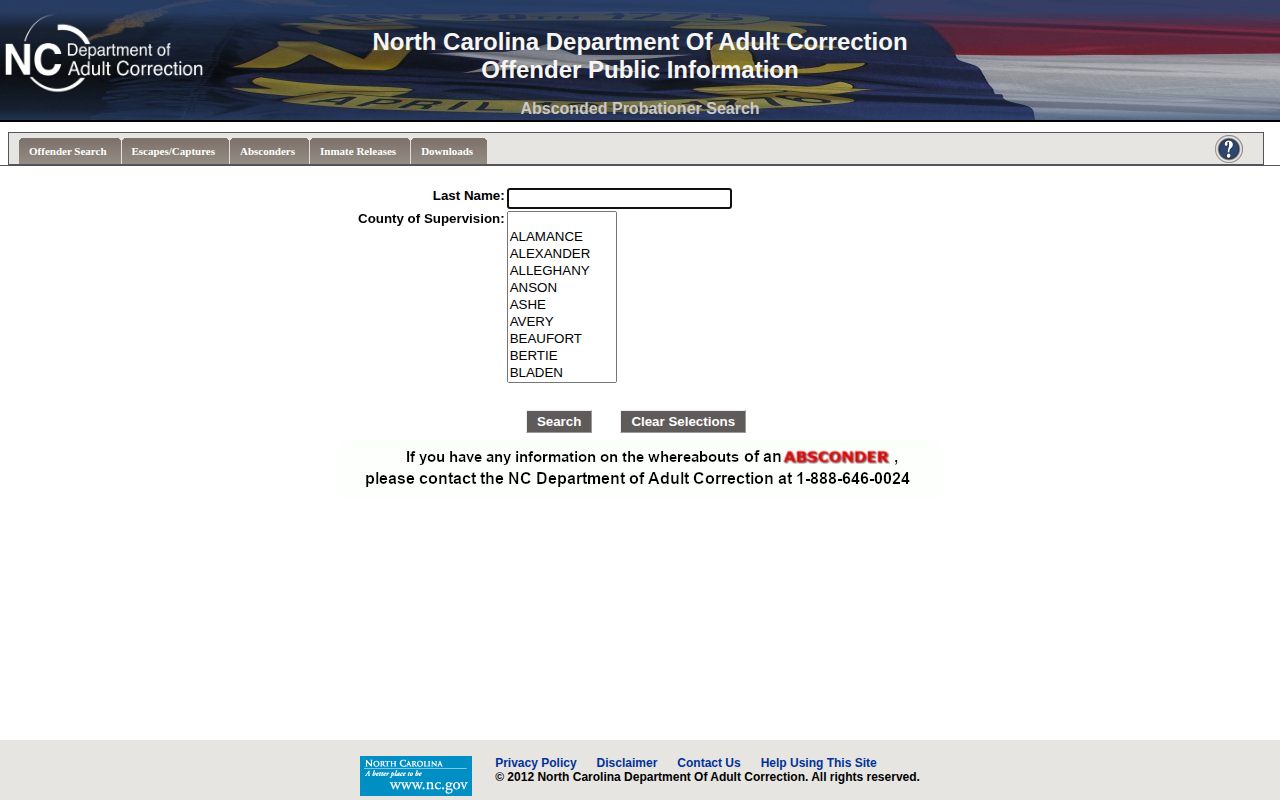
A matching row should be cross-checked against the individual offender record and District 16. Status may change, and the entry alone does not establish a new Hoke County booking.
Hoke County Supervision Conditions
The Commission establishes conditions for parole and post-release supervision and can modify them or address revocation matters. Probation conditions arise through the court and are administered in the field by NCDAC Community Supervision. The public locator may show the supervision track, office, service status, and dates, but it does not turn every part of the underlying file into a public record.
When a custody change occurs, NC SAVAN can provide notifications tied to county jail or OPUS data. A notice should still be matched to the contributing agency. A Hoke jail event and a state Community Supervision event are not interchangeable, even when they involve the same person.
North Carolina Parole Reviews
North Carolina does not publish a conventional calendar of ordinary individual parole hearings. Commissioners generally review a file and vote independently rather than meeting as a group or meeting face-to-face with the offender. A majority approves or denies. A narrow videoconference exception applies to certain people convicted as juveniles and sentenced to life with parole eligibility, but that does not make ordinary reviews public hearings.
Eligible cases are generally reviewed at least once each year. First- or second-degree murder cases are reviewed every three years, while sexually violent offense cases are reviewed every two years. Those intervals describe review cadence, not a release appointment. The Commission considers the offense, prior record, prison conduct, program work, and input from court officials, victims, and other interested parties. If further review is warranted, staff examine release plans and seek additional views.
Note: A review interval describes when the Commission reconsiders an eligible case, not when the person will leave prison.
Check Hoke Parole Review Results
The Commission's Monthly Discretionary Parole Reviews page publishes spreadsheets beginning with September 2024. Search a workbook by OPUS number or name, then note the review month, parole type, decision, and any official denial-reason field. The sheets include identity fields, primary offense, time served, sentence imposed, parole type, decision, and coded denial reasons.
| APPROVE | The Commission approved parole in that review. It does not by itself prove that physical release has occurred. |
|---|---|
| DENY | Parole was not approved in that review. Registered interested parties may receive the next review information. |
| SUSPEND or INCOMPLETE | Do not report these as grants. Check a later workbook or contact the Commission for clarification. |
After any approval, search the same OPUS number in the Offender Locator. Confirm Inmate Status, Actual Release Date, supervision status, and the newest sentence. Planning, another sentence, a detainer, or later action can stand between approval and physical release.
Hoke County Parole Eligibility
Offense date is the key starting point. Traditional parole may apply to crimes committed before October 1, 1994, subject to the sentence type and exclusions. G.S. 15A-1371 contains older-law eligibility rules, including special Fair Sentencing, DWI, and community-service-parole provisions. Some sentence types do not qualify. A conviction label by itself cannot resolve eligibility.
For crimes committed on or after October 1, 1994, Structured Sentencing eliminated traditional parole. A felony prisoner serves the required prison portion and then moves to post-release supervision. The Commission sets conditions but does not vote on the ordinary release date. Ninety-Day Mandatory Parole can apply near the end of certain felony Fair Sentencing terms for crimes in the older 1981 through 1994 period, but the Commission says it has no discretionary review authority over that release type.
Hoke County Reentry Council
NCDAC publishes a local Hoke Reentry Council as a transition-navigation route for people returning to the county. This is distinct from Community Supervision. A reentry council helps connect people with local services, while an officer and the Commission administer legal supervision and conditions.
Use the NCDAC Local Reentry Councils directory for the current Hoke phone and two listed email contacts. The official directory is the right place to check them because staffing and service points can change. Contacting reentry staff does not verify that supervision is active or alter a condition; those questions stay with the assigned office.
Note: Reentry staff can help navigate services, but only the assigned supervision office can verify a person's legal supervision status.
How Hoke County Supervision Ends
Completion must be read from the correct legal track. Under G.S. 15A-1372, parole generally lasts no more than one year and completion terminates the sentence. G.S. 15A-1368.2 separately governs post-release supervision lengths and termination. Probation ends under its court order and supervision record. These categories should not be merged simply because a public database groups their status fields.
Check the newest supervision period, end date, sentence status, and top supervision status. If the record remains active after an expected date, ask District 16 about the current public status rather than assuming a lag or closure. If it is inactive, retain the OPUS number and relevant sentence period when requesting an existing NCDAC record. NCDAC makes basic conviction, sentence, time served, admission, and release-date information public, while much of the full offender file remains confidential.