
Hoke County Projected vs Actual Release
The North Carolina Department of Adult Correction uses two separate sentence-history fields. Projected Release Date is forward-looking and calculated. Actual Release Date records when the represented NCDAC incarceration period ended. A projection is not a promise, and an actual date does not by itself prove that the person entered the community without supervision or another hold. The individual record must be read with Inmate Status, Probation/Parole/Post Release Status, Service Status, and location data.
Scheduled versus actual: a projected date may change; an actual date confirms the end of that NCDAC custody event, not freedom from every agency.
A pretrial detainee at the Hoke County Detention Center is different. No sentence computation can supply a firm exit date before the court acts. Bond may be posted, a magistrate or judge may alter conditions, charges may be resolved, or another agency may assume custody. The jail can confirm whether Hoke custody ended, while the court record supplies the legal order. For local custody, the useful pair is therefore the jail record plus the Hoke County case, not a state-prison projection.
Find a Hoke County Release Date
Start with the agency that held the person. NCDAC’s public locator covers state prisoners, probationers, and parolees, with historical information reaching back to 1972. It expressly does not cover county-jail custody. The separate monthly Inmate Release Search can be filtered by Hoke, year, and month, but it is a state-system release tool rather than a county-jail list. A released-first search should use the main locator’s All status because an Active Inmate filter can hide the record being sought.
- Open the NCDAC criminal offender search gateway and use the state offender number when known.
- Otherwise search the exact name with date of birth, age, race, or other shown fields to separate people with similar names.
- Open the individual record and find the newest incarceration sentence block, not merely an old historical block.
- Read Projected Release Date, Actual Release Date, Service Status, sentence status, location, and supervision status together.
- For a Hoke jail detainee, call the detention center and then check the court case instead of applying the NCDAC date.
- If another hold or transfer is possible, continue with the named county, federal, immigration, or state agency.
The broader Hoke County released-inmate search path explains how to follow a person across local, state, and federal systems when the initial agency is unclear. A no-result is not proof of release. It can reflect a spelling mismatch, a status filter, a lag, a sealed matter, or custody in a system outside NCDAC.
Note: NCDAC’s public locator excludes county-jail records, so a missing state result does not answer whether Hoke jail custody ended.
Hoke County State Release Search
NCDAC also publishes a dedicated monthly release query. Choose Hoke, a year, and a month, or search by surname. Results identify offender number, name, Release Date, Primary Offense with qualifier, and Type of Release. The linked individual page then provides the sentence detail needed to interpret that row. A Hoke filter should not be described as the prison location or county of conviction without checking the full record.
The official NCDAC release form shows how county, month, year, and surname work as search inputs.
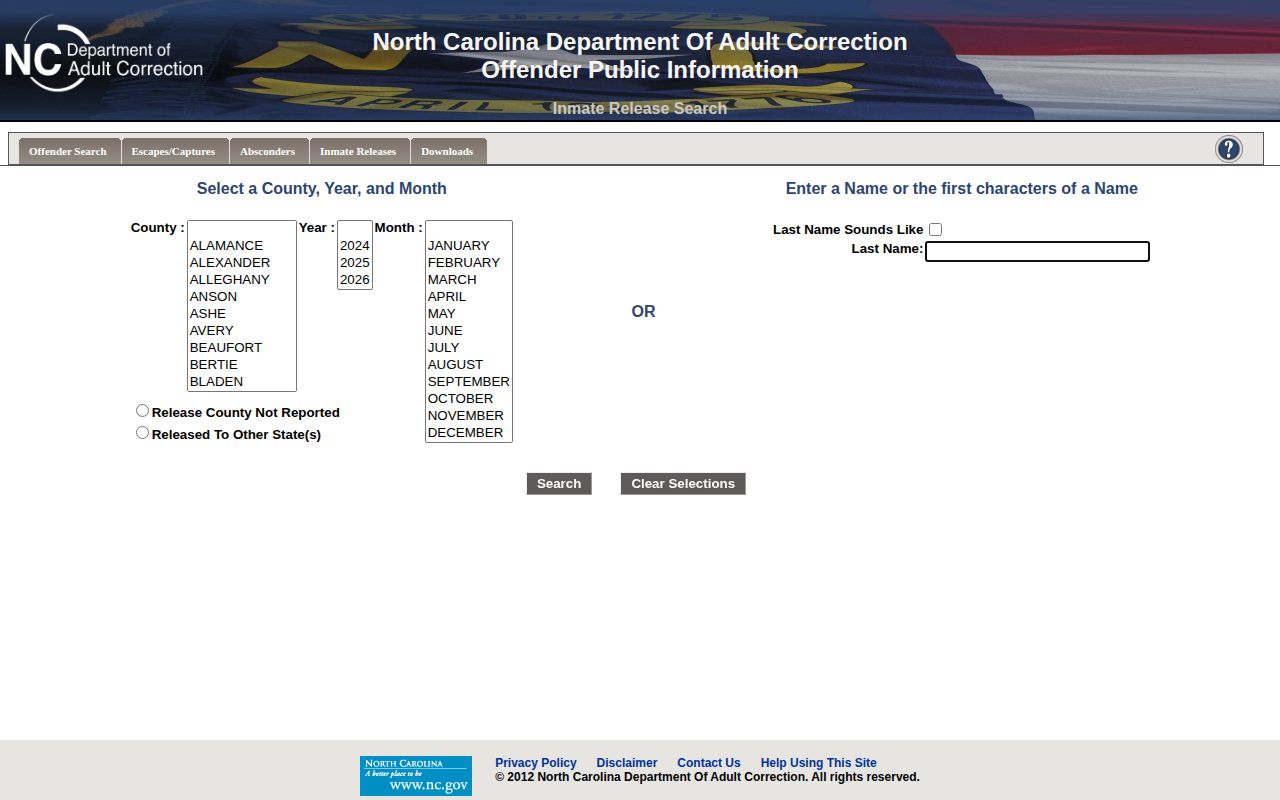
This monthly route is useful for locating a completed state event, but it cannot calculate a county-jail release or replace the sentence history. The result’s Type of Release and date are leads. Confirm them against the current and historical blocks before reporting whether the person left prison for post-release supervision, parole, another jurisdiction, or sentence expiration.
If the public result is unclear, NCDAC accepts records requests for basic public offender facts such as conviction, sentence length, time served, admission, and release dates. Give the offender number, full name, and sentence period. Most of the underlying correctional file remains confidential, so request the existing date record rather than an explanation or a new calculation.
Hoke County Release Minimum Rules
North Carolina’s Structured Sentencing framework applies to crimes committed on or after October 1, 1994, subject to specialized provisions. The state Parole Commission’s authoritative summary is that traditional parole was eliminated for those cases and the person must serve at least 100 percent of the minimum sentence and 85 percent of the maximum sentence. Saying only “85 percent” omits the controlling minimum-service floor.
G.S. 15A-1340.13(d) requires an active felony offender to serve the minimum term imposed. Earned time may reduce the maximum, but it may not reduce service below that minimum. G.S. 15A-1340.17 supplies paired minimum and maximum terms. For specified longer B1 through E terms, maximum construction adds a percentage, rounding, and a supervision component. Covered reportable offenses use a larger supervision component. These rules explain why informal sentence multiplication cannot yield a reliable personal date.
The maximum-term tables add more than a simple percentage. For specified long B1 through E felony minimums, the maximum is the minimum plus 20 percent, rounded to the next month, plus 12 months. A covered reportable B1 through E offense uses a 60-month addition instead of 12 months. Those added months create the statutory space for the prison term and post-release-supervision component. They are not a bonus sentence imposed later by NCDAC. The exact table row in the judgment still controls.
This construction also explains how the 100-percent-minimum and 85-percent-maximum statements can both be accurate. In an ordinary Structured Sentencing case, the minimum remains a firm prison-service floor. Earned time works against the maximum side, and the applicable supervision period is removed when NCDAC computes the transition to post-release supervision. A projected exit from prison can therefore occur before the calendar maximum while the person continues serving the sentence in the community. Sentence termination comes later, after the supervision portion is completed or lawfully reduced.
Older Fair Sentencing and parole cases follow different credit and eligibility law. Their projected fields may reflect max-out while an earlier actual date reflects parole. The offense date, judgment, sentence type, and sentence relationships must be identified before any formula is discussed. A rule written for a current Structured Sentencing felony should never be projected backward onto an older parole-eligible case.
Hoke County Earned Release Credit
North Carolina law uses earned time, not an unlimited “good behavior discount.” G.S. 148-13 directs the Secretary to set rules for earning and forfeiting authorized sentence credit. NCDAC’s policy index identifies Sentence Credits as policy C.3000. For Structured Sentencing felonies, credit can reduce the maximum but cannot cross the judicial minimum. For activated misdemeanors, G.S. 15A-1340.20(d) caps combined earned time under the statute and rules at four days for each month of incarceration.
Post-release supervision is part of the sentence rather than proof that it has terminated. Under G.S. 15A-1368.2, ordinary B1 through E felony prisoners generally move to post-release supervision at maximum minus 12 months, less awarded earned time. F through I cases generally use nine months. Covered registration offenses have a five-year supervision component. Compliant participation in specified reintegrative conditions may reduce supervision by no more than 20 percent of its original length.
The statute page documents the max-minus-supervision framework used to understand a projected state release.
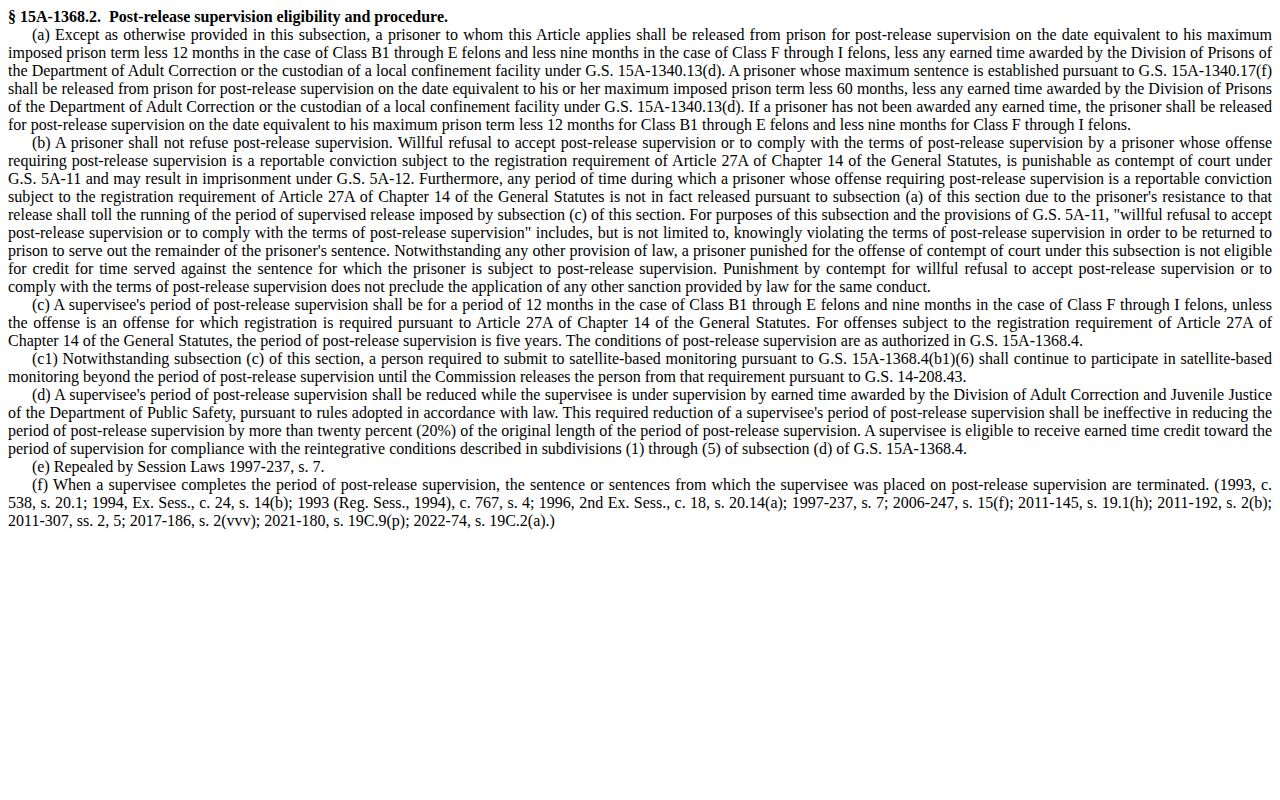
The displayed projection still comes from NCDAC’s application of the judgment and record. Credit awards, forfeitures, jail credit, and sentence relationships are case facts. They should be read from the official record rather than reconstructed from a broad percentage.
Note: A post-release supervision reduction cannot exceed 20 percent of its original term under the cited North Carolina provision.
How Hoke County Release Is Computed
A state calculation begins with the judgment, not the web result. First identify the offense date and sentencing regime. Then read the minimum and maximum terms, sentence-begin date, prior-custody credit, and whether multiple terms are concurrent, consecutive, or consolidated. Apply the statutory minimum-service floor and the correct post-release-supervision component. Only then can authorized earned-time awards and forfeitures affect the maximum-side calculation.
Several checks follow. A corrected jail-credit entry can move the date. Revocation may add a new custody period. A corrected judgment, new sentence, detainer, warrant, pending charge, or court order can alter the computation or where the person goes. Once the event occurs, the Actual Release Date, current inmate status, supervision status, and current location must be checked again. The date alone cannot reveal destination.
| Factor | Possible effect on the Hoke County release date |
|---|---|
| Earned-time award | May reduce the maximum-side calculation, but not below a Structured Sentencing felony minimum. |
| Disciplinary forfeiture | May remove previously available sentence credit and move the projection later. |
| Jail-credit correction | Changes credited pre-sentence custody and may move the computed date. |
| Sentence relationship | Concurrent, consecutive, and consolidated terms produce different aggregate results. |
| Court or revocation order | Can change the lawful term or create another custody period. |
| Detainer or warrant | May change the destination even if the NCDAC sentence event ends as projected. |
Hoke County Jail Release Timing
The Hoke County Detention Center is at 125 E. Edinborough Ave. in Raeford. Jail/Inmate Information is 910-875-5113, with listed hours Monday through Saturday from 8 a.m. to 5 p.m. The jail provides charge and bond-condition information, but it expressly does not set bond, change court dates, decide guilt, or impose punishment. Those limits matter when someone asks for a projected county-jail date.
A pretrial stay can end through bond or court action, so the jail and court answer different parts of the question. Ask the jail whether Hoke custody ended, when it ended, and whether the record indicates community release or transfer. Use the Hoke County court contact directory or case portal to identify the bond order, judgment, dismissal, or other legal action. A future court date can coexist with release before trial.
A locally activated misdemeanor sentence may involve earned time under state law, but no Hoke-specific public calculator or release-date portal was found. Do not apply the state-prison display mechanically to a jail stay. Ask for the existing admission, release, sentence, and credit record. If the person was transferred, follow the receiving agency because the end of Hoke custody is not the end of custody overall.
Note: The Hoke detention page promises charge and bond-condition information, not an online projected-release calculation.
Confirm Hoke County Actual Release
A historical NCDAC sentence block can retain a projected date later than an earlier actual parole date. A current block may show matching projected and actual dates once the calculation is reached. A blank actual field means the represented release has not been recorded in that block; it should not be filled by assumption. Always distinguish a projected field from a completed event.
NCDAC policy also recognizes destination-changing exceptions. Pending charges, an outstanding warrant, or the lack of an approved home plan can prevent an ordinary direct community release. A sheriff may pick up the person for local custody, a safekeeper may return to the sheriff, or a court order may direct release after state processing. Pair the state field with county or federal checks when another hold is plausible.
State-prison discharge logistics are governed separately from the date computation. G.S. 148-13 authorizes rules for cash, clothing, and other discharge or parole allowances. For a prisoner discharged or paroled after at least two years, the statutory cash award must be at least $45. That allowance applies to qualifying state-prison releases. It does not document a Hoke County jail payment, and it should not be used to infer when a local detainee will leave custody.
The public NCDAC released-to-supervision example shows why separate inmate, sentence, and supervision fields must be read together.
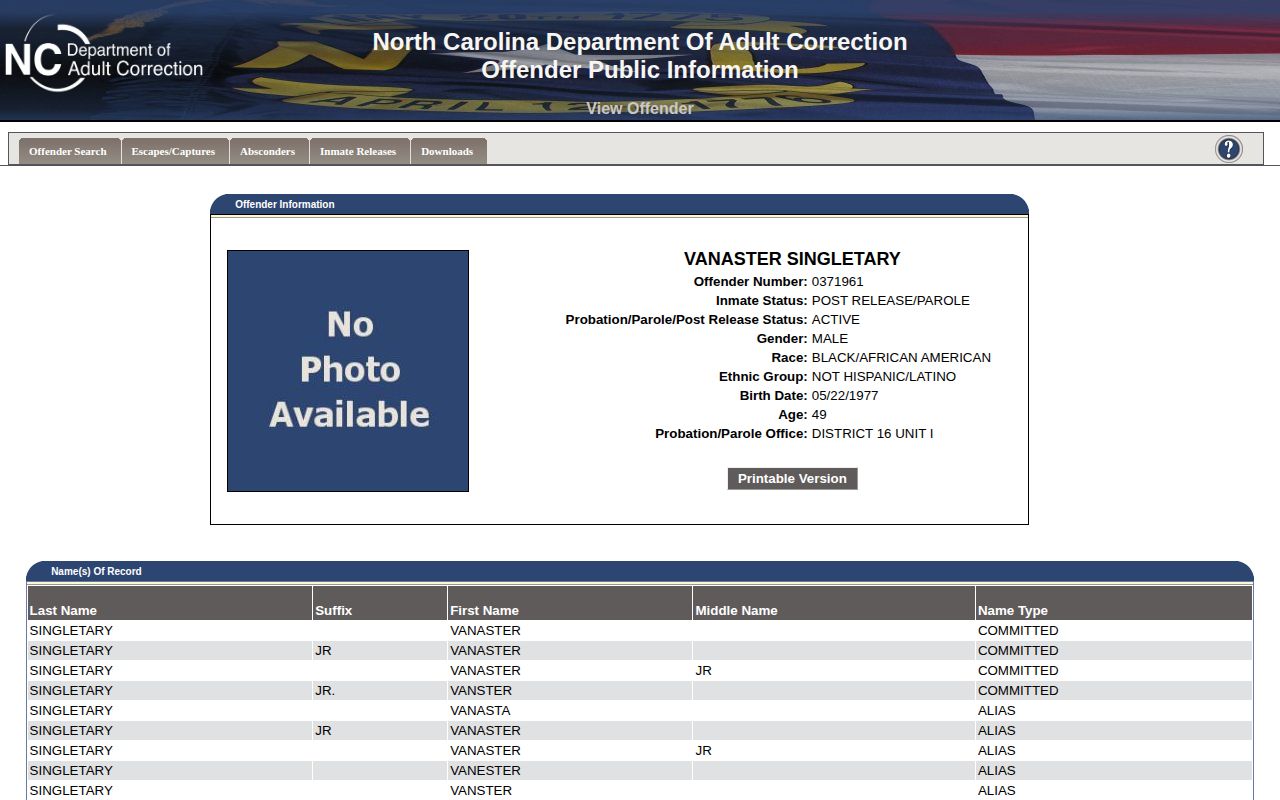
For a pending event, the Hoke County VINELink check explains how to match one person and register for offered status alerts. Treat an alert as an agency status event, then confirm the physical exit, legal reason, and destination with the agency that supplied it.