
Understanding Hoke County Releases
Hoke County released inmates leave one specific custody event, but that event may end in several ways. The Hoke County Detention Center can release a person on bond, under a court order, or after a local term. It can also transfer that person. NCDAC can release a state prisoner to post-release supervision, parole under older law, sentence expiration, or another agency. A federal system creates its own record.
The word release must stay tied to the releasing custodian. Exit from Hoke County custody does not prove freedom from NCDAC, BOP, ICE, another county, or the U.S. Marshals Service. A released name also usually drops from a current roster. The durable evidence is the release or movement record, the court order, and the next agency's status.
- Discharge
- The stated custody or sentence obligation ends under the governing record.
- Time served
- The ordered confinement in a matter has been completed, though another hold can remain.
- Probation
- Court-ordered community supervision that may replace or follow confinement.
- Post-release supervision
- The community portion of a Structured Sentencing felony term after prison custody.
Hoke County Release Outcomes
The correct lookup depends on the recorded outcome. Hoke jail staff can confirm the end of local custody, but the jail does not set bond, change court dates, decide guilt, or determine punishment. The court record supplies the legal basis. State and federal systems become relevant only when the person enters or leaves those systems.
| Release type | Meaning | Where to verify |
|---|---|---|
| Bond | Pretrial detention ends under court-set conditions | Jail event and court bond order |
| Dismissal or court order | The court supplies authority that may end custody | Signed order plus jail exit record |
| Time served or expiration | The stated confinement ends, subject to another hold | Judgment and release record |
| Transfer | One agency's custody ends while another begins | Sending and receiving agency records |
| Parole or post-release supervision | Prison custody ends while supervision continues | NCDAC offender and supervision fields |
Read Hoke County Release Records
Hoke County does not publish an online release-record data dictionary. Request only fields the agency actually keeps and report only what the response supplies. The best local chain pairs the jail custody record with the Hoke court case. The first can show when county custody ended. The second can explain bond, dismissal, plea, judgment, sentence, and later court dates.
| Requested field | What it can establish |
|---|---|
| Booking number | Links the admission and release to one jail event |
| Admission date and time | When the Hoke custody event began |
| Release date and time | When Hoke custody ended |
| Release reason or type | The custodian's recorded category |
| Bond information | Conditions tied to a pretrial release |
| Destination or agency | Whether the event ended in a transfer |
| Booking photograph | An image tied to the booking, not proof of later release |
A future court date can remain after valid pretrial release. Roster disappearance with no court outcome can mean transfer. Treat blanks as blanks. Do not fill a missing release reason from an assumption.
Note: A release record and court file complement one another, but neither should be used to invent a field the custodian did not record.
Request Hoke County Release Records
Direct a county-jail request to the Hoke County Sheriff's Office or detention-record custodian. Identify the person and booking event closely. North Carolina law does not require the office to answer questions or create a new report, so ask for the existing booking and release record and its stated fields.
- Provide the full name, date of birth if known, approximate booking date, and booking or case number when available.
- Ask for admission and release times, release type, bond data, transfer notation, and the booking image if it is disclosable.
- Request an electronic copy and advance notice of any actual-copy or special-service charge.
- Ask the custodian to cite the legal basis for withheld material and release the separable public remainder.
- If no record is found, ask whether another agency holds a transfer receipt, court order, or related entry.
125 E. Edinborough Ave., Raeford, NC
Mail: P.O. Box 300
910-875-5113
Monday through Saturday, 8 a.m. to 5 p.m.
The county's incident-report form is not labeled as a release-record or booking-photo form, and no local fee or turnaround was found. Call the jail to identify the correct route. G.S. 132-6 requires copies as promptly as possible, but it gives no fixed statewide day count.
Hoke Release Record Law
G.S. 132-1 broadly defines North Carolina public records and expressly includes photographs and electronic data. That is the starting point for existing booking entries, release ledgers, and government booking images. It does not make every item in a sheriff's investigative file public.
G.S. 132-1.4 governs criminal investigation and intelligence records while identifying core arrest information that remains public. G.S. 132-6 covers inspection, prompt copies, the no-purpose rule, and separation of confidential fields. G.S. 132-6.2 permits a medium the agency can provide and normally limits uncertified-copy cost to actual reproduction expense. Extensive technical or staff work can support a reasonable special-service charge.
Note: Chapter 132 provides access to existing public records; it does not require Hoke County to create a new explanation or recreate destroyed material.
Hoke Release Record Retention
An online display window and legal retention are different. No Hoke County release archive duration was found. The North Carolina Department of Natural and Cultural Resources publishes local-government retention schedules, but the exact sheriff or detention series must be checked before stating how many years a record remains. A missing web result does not show that the underlying booking or release record was destroyed.
If a record was lawfully destroyed, request related existing material such as the arrest entry, commitment or release order, bond paperwork, court judgment, transfer receipt, or receiving-agency intake. Expunction creates a separate limit. North Carolina describes expunction as a process that can seal or destroy records of an arrest, charge, or conviction. An old private copy cannot restore the public status of an official record removed by law.
The official North Carolina expunction instructions are captured below. They explain why an older case trail may lawfully disappear.
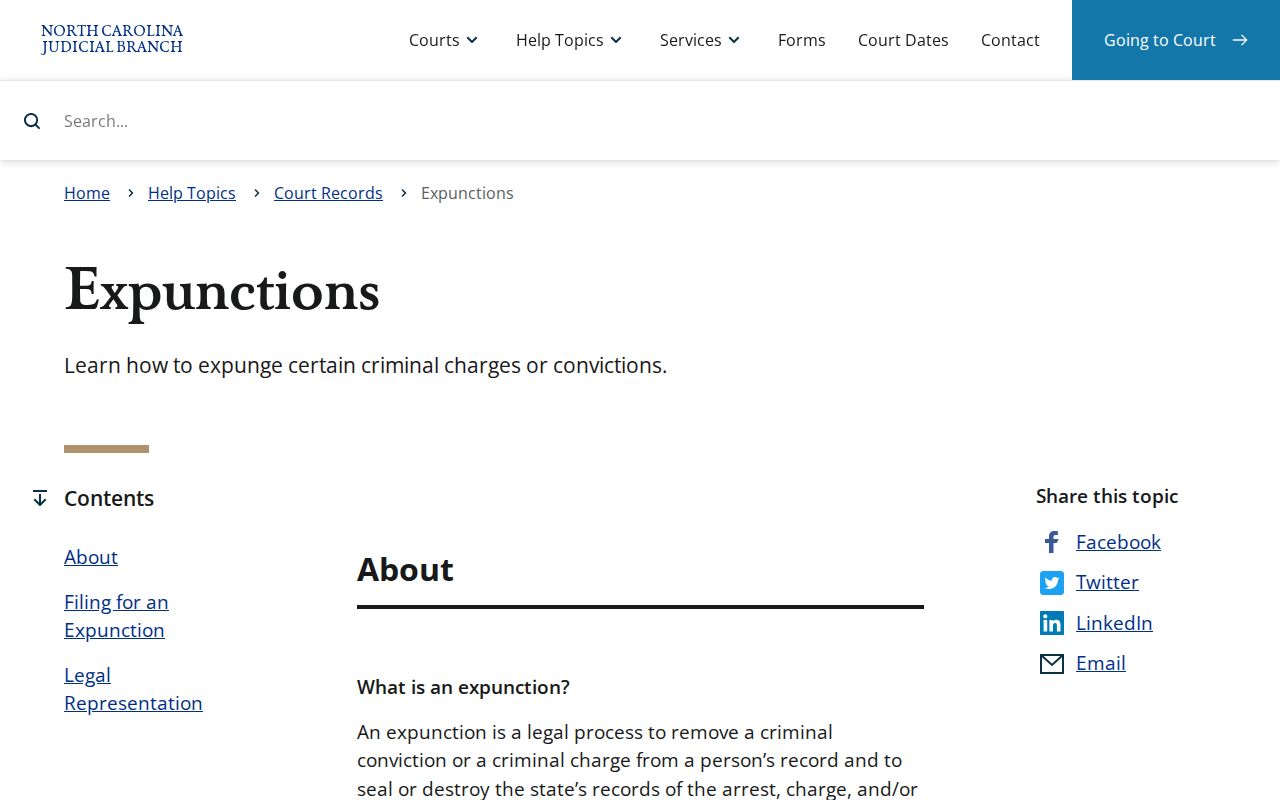
The image supports the access caveat. It does not establish whether any named person's case was expunged.
Find Hoke County Released Inmates
A complete search starts with custody type. NCDAC excludes county-jail records, and the Hoke jail page does not publish an official 24-hour or 72-hour release feed. Search tools must be used in the right order.
- For a Hoke jail event, check the official sheriff app's current inmate search, then call 910-875-5113 to confirm whether and how Hoke custody ended.
- Locate the Hoke court case through Portal or the clerk. Read bond, disposition, judgment, and commitment entries without treating the docket as a physical exit log.
- For state custody or supervision, search NCDAC with status set to All and review the newest sentence history.
- Use NC SAVAN or VINELink for a participating county or state status event and release notifications.
- Check BOP, ICE, or federal court sources only when federal custody is plausible.
- Request the existing release record when online sources do not supply the time, type, or destination.
Note: Start with the agency that last held the person, then follow a named transfer instead of repeating the same search in every system.
Search Hoke State Releases
The NCDAC search gateway says the state locator covers prison offenders, probationers, and parolees, reaches back to 1972, and excludes county jails. Use the seven-digit offender number when known. Otherwise search the exact name and use birth date, age, middle name, race, or other shown data to separate matches.
| Search field | Best use |
|---|---|
| Status: All | Find active inmates, supervisees, and inactive history |
| Offender number | Match the stable state identifier |
| Name and sounds-like option | Find records when spelling varies |
| Birth date or age range | Separate people with similar names |
| County/month release search | Find state releases associated with a Hoke filter |
Open the individual record and read Inmate Status separately from Probation/Parole/Post Release Status. Actual Release Date is retrospective. Projected Release Date is calculated and can change. The monthly NCDAC release search also accepts Hoke, year, and month, but it is not a rolling county-jail list.
Who Controls Hoke Releases?
Hoke's jail and courts answer different questions. The official detention center page says staff can provide charge and bond-condition information and confirm the custody event. It expressly states that the jail does not set bond, change court dates, render verdicts, or determine punishment. Those legal actions belong to the magistrate and courts.
Call the jail to confirm whether and when the local custody event ended. Ask the magistrate or clerk about the legal authority. This two-source method prevents a bond figure or future calendar date from being treated as an actual exit time. It also prevents an app disappearance from being misreported as a court dismissal.
Does a court dismissal prove the exact release time? No. It may explain why custody should end, but the jail's release entry is the better record of physical departure and destination.
Trace Hoke Releases in eCourts
Hoke County adopted eCourts in October 2024. The official Hoke County court page links the statewide Portal and court calendars, so the case trail can remain available after a short jail event no longer appears in current-custody data. Search the exact name or known file number, select the correct case category and county, and compare identifiers before opening a result.
Note the file number, division, charge dispositions, judgment descriptions, bond entries, and commitment or release-related events. Portal can help identify the record, but an incomplete display should be followed by a clerk-office terminal or a request for the actual signed document. The Hoke County Clerk of Superior Court holds individual county case files. The central NCAOC public-record request form is for administrative records and is not a substitute for the clerk.
A portal no-result does not prove that no Hoke custody event occurred. The spelling or county may differ, the case may predate displayed data, or the file may be confidential, sealed, or expunged. Court status explains legal authority; jail status establishes the local physical custody change.
Note: Save the Hoke file number before requesting a judgment because names alone can produce incomplete or mistaken matches.
Verify Hoke Release Supervision
North Carolina calls its VINE layer NC SAVAN. It is a free, anonymous custody-status and notification service linked to the state OPUS system, and state policy says county jails use SAVAN for notifications. A Hoke jail event and an NCDAC prison event still come from different contributing agencies, so read the agency label before relying on an alert.
State notices can distinguish release with supervision from release without supervision. The first means prison custody ended while conditions continue. Verify the assigned office, status, and parole begin or end fields in the NCDAC record. Hoke belongs to Community Supervision District 16 with Robeson and Scotland counties. The current field listing places district management in Lumberton.
A VINELink release alert confirms that the contributing agency posted a custody change. It does not rule out a detainer, transfer, or later booking. For a formal time, reason, or destination, obtain the release record from the contributing county or state custodian.
Hoke Release Reentry Council
The Hoke Reentry Council listing adds a local transition-navigation route after custody. NCDAC publishes the council at 910-565-2299 ext. 3, hoke.casemgr@mocedc.com, and hokecounty.reentry@mocedc.com. Those contacts can help connect a returning resident with local resource navigation.
The council does not hold the jail release sheet, control an NCDAC sentence, or replace the assigned probation or parole officer. Confirm custody through the jail or NCDAC, confirm court authority through the case file, and use the council for transition needs. Keeping those roles separate directs each question to the office that can answer it.
Travel After Hoke Release
Hoke Area Transit Service is county-operated, door-to-door transportation, but it is appointment-only. Its page does not advertise automatic jail pickup or a detention-center stop. Anyone considering that route should call 910-875-8696 in advance and confirm eligibility, time, and pickup arrangements. Do not assume a ride will be waiting when processing ends.
Release time and door, property return, account closure, family waiting, weekend practice, and transportation are not published on the jail page. Call the facility before making a plan. The family and visitor guide concerns current custody and cannot be converted into unsupported post-release procedure.
Transportation planning does not confirm the release itself. Pair any travel plan with the jail's custody confirmation and the court or receiving-agency record.
Check Hoke Federal Releases
The BOP Inmate Locator covers federal inmates from 1982 forward. Search a register or other federal number when possible. Results show a release date and location. A location of Released or Not in BOP Custody proves only that BOP custody ended. The person may remain in another system or under federal supervision.
ICE's Online Detainee Locator is mainly a current location tool, not a historic release list. A no-result can reflect identity mismatch, lag, transfer, or limits on public coverage. USMS manages much federal pretrial custody but has no comparable public release locator. Use the federal docket, counsel, or a narrow USMS records request where needed.
- Still in Hoke jail: use the jail or sheriff app, remembering that current data is not release history.
- Released from state prison: use NCDAC sentence history, which excludes county jail events.
- Released from BOP: use the federal locator, then check whether another custody or supervision remains.
- Currently held by ICE: use ODLS, but never treat a no-result as proof of release.
Note: Federal locators answer only their own custody question and do not replace a Hoke County booking or release record.
Hoke County Release Facilities
Hoke County Detention Center is the active county jail. Its release record and the court case distinguish community release from transfer. Call the jail when the app or current-custody information no longer shows the person.
No separate Raeford municipal jail, BOP prison, ICE detention center, or USMS detention facility in Hoke County was established by the reviewed official sources. That is a bounded finding, not proof that no other agency ever assumes custody.
Was Hoke CI Release?
Hoke Correctional Institution is a closed state prison with a distinctive custody trap. State officials suspended operations in September 2019, reassigned staff, and moved prisoners to other minimum-custody facilities across North Carolina. NCDAC's closed-prisons list later recorded the institution as closed in February 2022.
Leaving the Raeford site during that relocation was transfer, not discharge. The person remained an NCDAC prisoner at the receiving location. To find the later outcome, search the stable offender number and review state movement, incarceration, Actual Release Date, and supervision fields. An old record that lists Hoke CI establishes a historic placement, not a current release gate.
This distinction also affects dates. The physical date a prisoner left Hoke CI can precede the Actual Release Date for the state sentence by months or years. Report those as separate events and never replace a missing discharge field with the facility's closure date.